|
|
 |
|
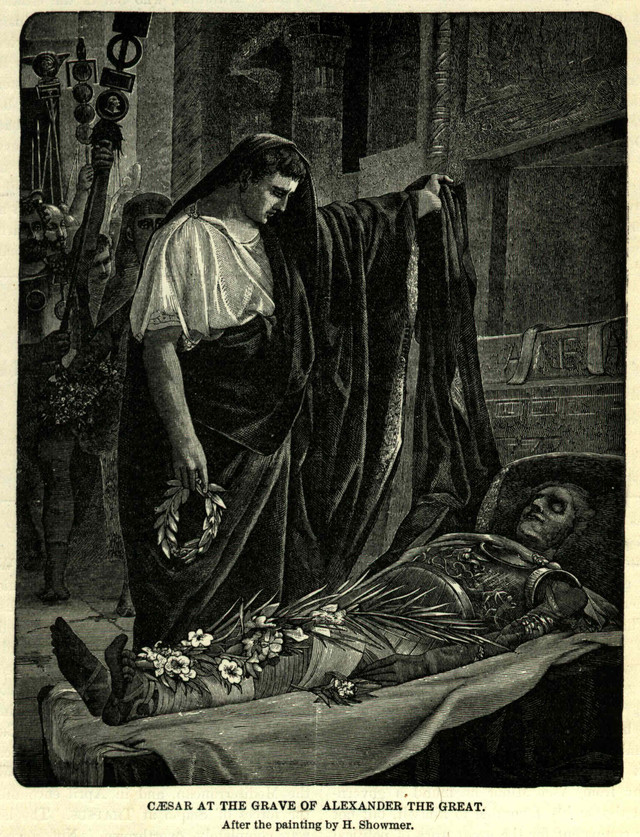
Saint Bollard
Patron of Dented Door Panels.
|
|
Piecing together the secret of victory . . . |
|
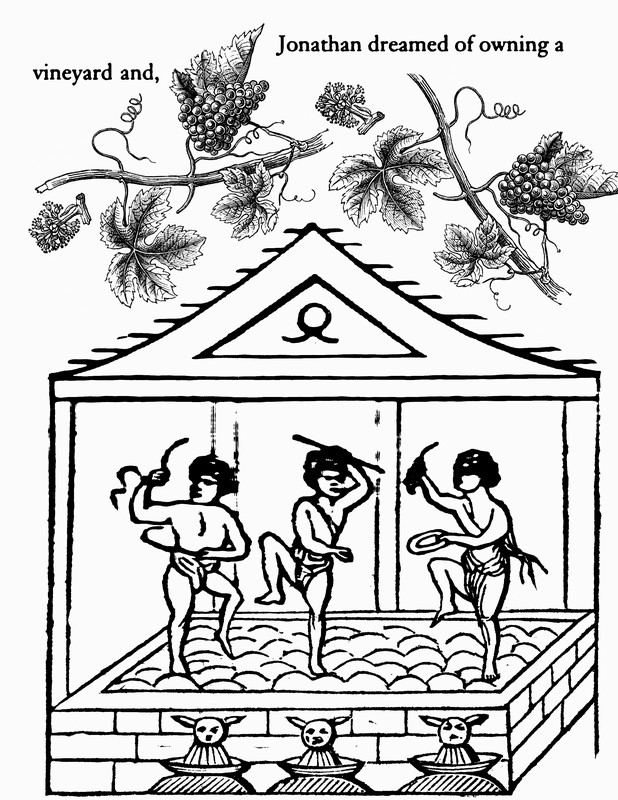
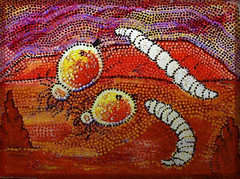
The painting was about four foot by three and had a background of pointillist dots in varying shades of ochre. In the centre there was a big blue circle with several smaller circles scattered around it. Each circle had a scarlet rim around the perimeter and, connecting them, was a maze of wiggly, flamingo- pink lines that looked a bit like intestines.
Mrs Lacey switched to her second pair of glasses and said, ‘What you got here, Stan?’
‘Honey- ant,’ he whispered in a hoarse voice.
‘The honey- ant’, she turned to the Americans, ‘is one of the totems at Popanji. This painting’s a honey- ant Dreaming.’
—Bruce Chatwin, The Songlines, 1987.
|
|
The following are examples of general properties: • being square • being self-identical • being identical with something • being next to someone • being next to a square • being a square which is larger than any other square — Gary S. Rosenkrantz, Haecceity: An Ontological Essay, 1993
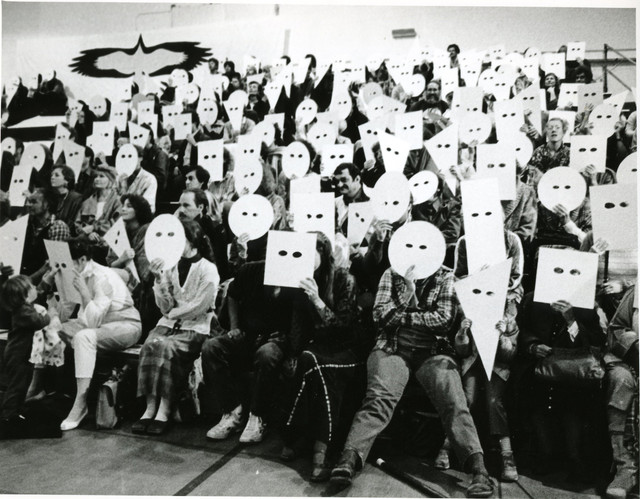
Anna Halprin , Circle the Earth, Dancing with Life on the Line, 1989 photo courtesy of Musee d'Art Contemporain de Lyon, image by Paul Fusco Via Yerba Buena Center for the Arts
|
|
| I Found a Penny Today, So Here's a Thought |
(permalink) |
|
|
|
  by Liza with a ZColoring By Hand: The American Sign Language SpectrumOf all the ways to talk about color, sign language must be the most expressive. If you don't already speak sign language, color words are a fun place to start. You'll learn that it doesn't take a palate to discuss a palette. Orange: This color sign pantomimes squeezing an orange fruit. In front of your mouth, form the letter "c" with your right hand (make a "c" shape by curving your fingers toward your thumb, as if you're grasping a can). Then squeeze your hand into a tight fist. Repeat this squeezing and inflating motion several times. Blue: Form the letter "b" (fingers extended and held tight, thumb tucked against the palm) with your right hand, to the right of your body. Slightly shake your hand to the right from the elbow, without bending the wrist. 
The sign for "blue" in American Sign Language.
by Vertigo25
Red: Touch your lips with the tip of your index finger. (All other fingers are gathered toward the palm.) With a downward motion, glance the top lip, then the bottom. This motion is performed once, though sometimes people double it. Brown: Form the letter "b" with your right hand (fingers extended and held tight, thumb tucked against the palm). Move your hand down the side of your right cheek, from your nose to the bottom of your mouth. Gold: Touch your right ear with your right index finger. As you move your hand away, form the letter "y" (thumb and pinkie outstretched, other fingers tucked into the palm). Then shake your hand slightly. Silver: Touch your right ear with your right index finger. As you move your hand away, form the letter "s" (a tight fist). Then shake your hand slightly. Yellow: Form the letter "y" (thumb and pinkie outstretched, other fingers tucked into the palm) with your right hand, to the right of your body. Gently shake your hand to the right from the wrist. White: Touch your chest with all the fingers and thumb of your slightly curved right hand. Move your hand away (about eight inches) while closing the fingers. Black: Form the letter "d" with your right hand (index finger extended, middle finger and thumb touching). Touch your forehead with your index finger, then move it toward the right, across the tops of your eyebrows. Gray: Spread the fingers of both hands. Move your hands in opposite directions, passing the fingers through the open spaces of each hand. Green: Form the letter "g" with your right hand (index finger and thumb extending as if to pinch, other fingers tucked into the palm). Slightly shake your hand up and down from the wrist. Pink: Form the letter "p" with your right hand (index and middle fingers extended, palm facing toward you). Draw your hand down your lips. Purple: Form the letter "p" (index and middle fingers extended, palm facing toward you) with your right hand, to the right of your body. Move it from side to side. For photos of color signs in action, see Dr. William Vicars' tutorial. For illustrations of color signs, see ASL tutor Joanne Mikola's website. [Read the entire article in my guest blog at ColourLovers.com.]
|
|
Piecing together the secret of the universe . . . |
|
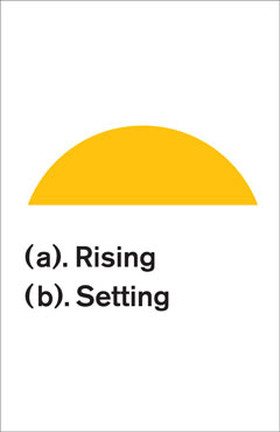
"How beautiful in the ambiguous glow, the sun not visible but poised over the horizon, either rising or setting." — Ward Just, The Translator
|
|
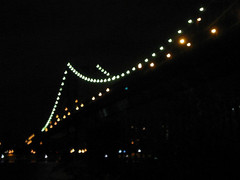
Nobody ever walked across the bridge, not on a night like this. The rain was misty enough to be almost fog- like, a cold gray curtain that separated me from the pale ovals of white that were faces locked behind the steamed- up windows of the cars that hissed by. Even the brilliance that was Manhattan by night was reduced to a few sleepy, yellow lights off in the distance.
—Mickey Spillane, One Lonely Night, as quoted by Ayn Rand in The Romantic Manifesto: A Philosophy of Literature.
|
|
|
|
|
|
| I Found a Penny Today, So Here's a Thought |
(permalink) |
|
|
|
Having created a coloring book that requires no crayons, an atlas of blank maps, and a dictionary of one-letter words, our new article on " one-bead rosaries" should come as no (or at least minimal) surprise. Here's an excerpt: A standard multi-bead rosary is symbolic of advancement, one bead progressing to the next. The one-bead rosary is an escape from the endless loops and recurring dramas of life. It is symbolic of arrival. How can one know one has arrived if one hasn't pinpointed a destination? The one-bead rosary encapsulates the power to seize destiny and make it one’s own.
Here's the online article. |
|
| I Found a Penny Today, So Here's a Thought |
(permalink) |
|
|
|
"In the psychological development of the child, there is a step-by-step progression from the primal smile to the smile of embarrassment, joyful laughter, laughter at a comic situation, laughter in a group, aggressive laughter at an outsider, and finally (a somewhat depressing climax) the laugher of Schadenfreude. ... [A]t each step laughter signifies an experience of relief ( Entlastung), both physically and psychologically." — Peter Berger, Redeeming Laughter: The Comic Dimension of Human Experience (1997)
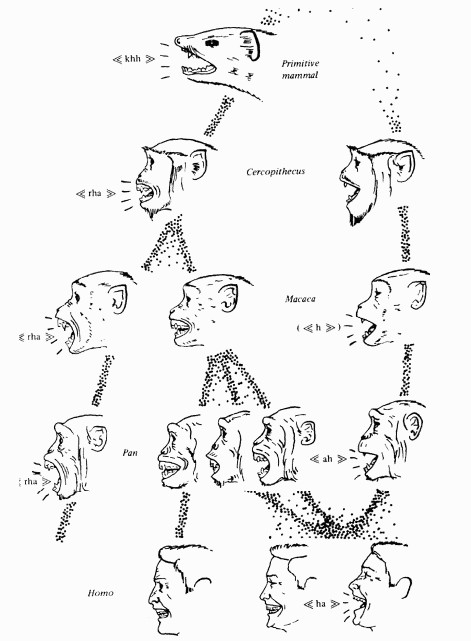
The evolution of the smile and laugh, from Frans de Waal's "Darwin's Legacy and the Study of Primate Visual Communication" ( PDF), via Cystalpunk.
|
|
Piecing together the secret of the unicorn horn . . . |
|
|
|
|
|
| I Found a Penny Today, So Here's a Thought |
(permalink) |
|
|
|
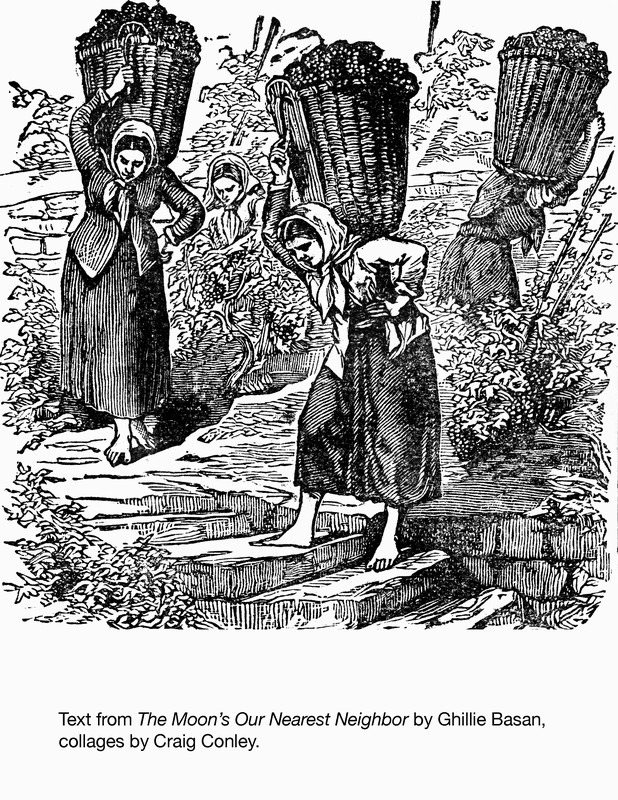
 by Sarah ReedConceptions of Color in a Colorless WorldA world devoid of color, posited John Arthur Thomson, "would not be uninteresting; but it would be very difficult and dull" (Riddles of Science, 1932). Even on the grayest of days, the human mind struggles to imagine a life destitute of color. However, sometimes imagination isn't required. Damage to the visual cortex can bring about Central Achromatopsia, a defect in color perception that renders the world into a "dull, dirty, faded, gray, washed out" wasteland like something on a black and white television (Alex Byrne and David Hilbert, Readings on Color, 1997). Besides being less pleasurable, a colorless world would be more difficult to navigate. Color experts Vernon Lee and C. Anstruther-Thompson explain how inhabitants of a colorless world would be strangers in a strange land: "Color gives the eye a grip, so to speak, on shape, preventing its slipping off; we can look much longer at a colored object than an uncolored; and the coloring of architecture enables us to realize its details and its ensemble much quicker and more easily. For the same reason colored objects always feel more familiar than uncolored ones, and the latter seem always to remain in a way strange and external; so that children, in coloring their picture-books, are probably actuated not so much by the sensuous pleasure of color as such, as by a desire to bring the objects represented into a closer and, so to speak, warmer relation with themselves" (qtd. in The Enjoyment and Use of Color by Walter Sargent, 1964). 

by WTL Photos
Even people without the faculty of sight must take color into account, Walter Sargent notes, "because they hear about it as one of the distinguishing qualities of objects." He cites the American activist Helen Keller, the first person with deafblindness to graduate from college. Keller used her imagination, analogies, and senses of touch, smell, and taste to develop her own conceptions of color. As she explained: I understand how scarlet can differ from crimson because I know that the smell of an orange is not the smell of a grape-fruit. I can also conceive that colors have shades and guess what shades are. In smell and taste there are varieties not broad enough to be fundamental; so I call them shades. There are half a dozen roses near me. They all have the unmistakable rose scent; yet my nose tells me they are not the same. The American Beauty is distinct from the Jacqueminot and La France. Odors in certain grasses fade as really to my senses as certain colors do to yours in the sun. . . . I make use of analogies like these to enlarge my conceptions of colors. . . . The force of association drives me to say that white is exalted and pure, green is exuberant, red suggests love or shame or strength. Without the color or its equivalent, life to me would be dark, barren, a vast blackness. (qtd. in The Enjoyment and Use of Color by Walter Sargent, 1964. Emphasis mine.) Though blind to the physical world around her, Keller could not and would not allow her thoughts to remain colorless. She always asked for things to be described to her in terms of color, so that she could imagine their resonance. "The unity of the world demands that color be kept in it whether I have cognizance of it or not," she explained. "Rather than be shut out, I take part in it by discussing it, happy in the happiness of those near me who gaze at the lovely hues of the sunset or the rainbow." The COLOURlovers library testifies to the fact that even colors and palettes seemingly devoid of pigment can be interesting. [Read the entire article in my guest blog at ColourLovers.com.]
|
|
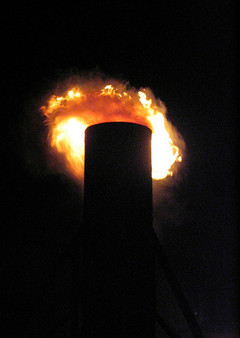
The fires from the foundry chimneys burning high and glaringly into the night, / Casting their flicker of black contrasted with wild red and yellow light over the tops of houses, and down into the clefts of streets.
—Walt Whitman, from "A Song of Joys"; quoted in Silences: Classic Essays on the Art of Creating, by Tillie Olsen, 1978.
|
Page 2 of 4
> Older Entries...
Original Content Copyright © 2026 by Craig Conley. All rights reserved.
|












 by
by