|
Where is the road?" some one shouted.
"On the blueprint, of course. . . . You’ve got it all in black and white.”
—Thomas Wolfe, Look Homeward, Angel, 1929.
|
|
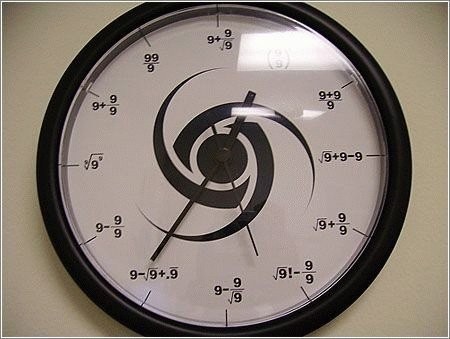
Is it nine o'clock already?
|
|
|
|
|
|
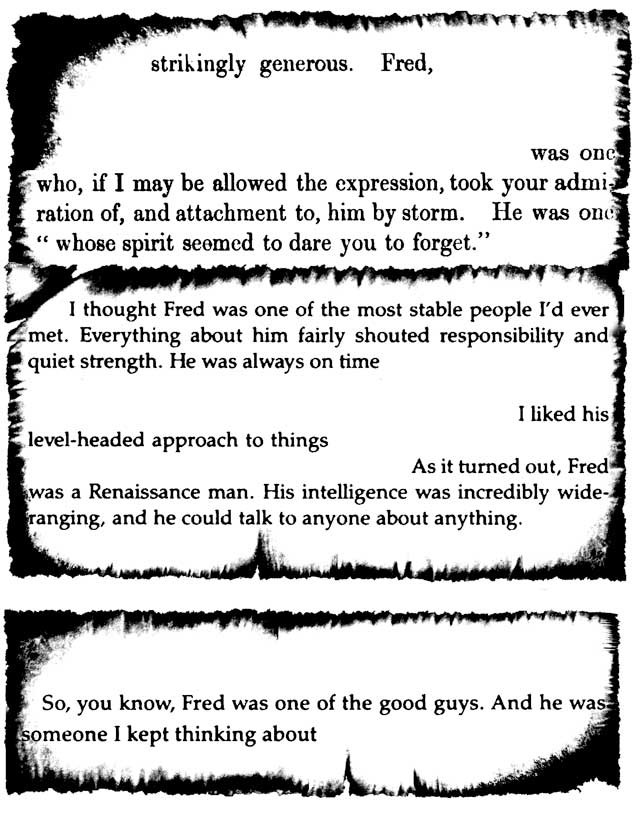
Here's a collage we assembled for a singular Fred and henceforth dedicate to all
the Freds of the world. |
|
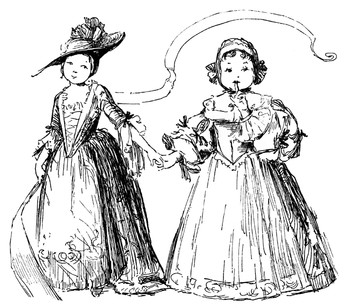
DEVICE: ‘Tis the Mode to express our fancie upon every occasion. . . . Shall I decipher my Colours to you now? Here is Azure and Peach: Azure is constant, and Peach is love; which signifies my constant Affection.
SISTER: This is very pretty.
DEVICE: Oh, it saves the trouble of writing. . . . [Y]our yellow is joy, because. . . .
LADY: Why, yellow, Sir, is Jealous.
DEVICE: No, your Lemon colour, a pale kind of yellow, is Jealous; your yellow is perfect joy. Your white is Death, your milke white innocence, your black mourning, your orange spitefull, your flesh colour lascivious, your maides blush envied, your red is defiance, your gold is avaritious, your straw plenty, your greene hope, your sea greene inconstant, your violet religious, your willow forsaken.
—James Shirley, ridiculing Device’s ribbons in Captain Underwit, early 1640s; quoted in Fashion and Fiction: Dress in Art and Literature in Stuart England by Aileen Ribeiro, 2005.
|
|
|
|
|
|
A sea of shining white mist was in the valley, with glinting golden rays striking athwart it from the great cresset of the sinking moon; here and there the long, dark, horizontal line of a distant mountain’s summit rose above the vaporous shimmer, like a dreary, sombre island in the midst of enchanted waters. Her large, dreamy eyes, so wild and yet so gentle, gazed out through the laurel leaves upon the floating gilded flakes of light, as in the deep coverts of the mountain, where the fulvous- tinted deer were lying, other eyes, as wild and as gentle, dreamily watched the vanishing moon. Overhead, the filmy, lace- like clouds, fretting the blue heavens, were tinged with a faint rose. Through the trees she caught a glimpse of the red sky of dawn, and the glister of a great lucent, tremulous star.
—Charles Egbert Craddock (Mary Noailles Murfree) (1850–1922), "The ‘Harnt’ that Walks Chilhowee," from In the Tennesee Mountains, 1884.
|
|
Piecing together the secret of wonder-working . . . |
|
A collaged story we assembled for a singular Donna and henceforth dedicate to all the Donnas of the world. Click on the thumbnails below to view an enlarged version in a new window. |
|
What's the opposite of "bon voyage"? In other words, what would the people standing on the ocean liner call down to those staying ashore? Would it be "joyeuse inertie"?
|
|
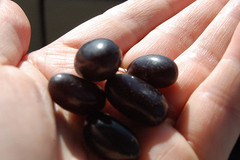
GEORGE BURNS: Going into the Pantages Theatre, there’s Gracie and Susan, and Harpo and myself. And he loved black jellybeans. He couldn’t get any black jellybeans, and all of a sudden there’s a little candy store next to the theatre. It’s during the war. All of a sudden he sees this candy store, and in the window there’s black jellybeans. He went in and he says, ‘How many black jellybeans have you got?’ The guy says, ‘Well, I got an order today, I paid thirty dollars for the black jellybeans.’ Harpo says, ‘I’ll give you thirty- five dollars for all the black jellybeans.’ Have you any idea how many jellybeans you can buy for thirty- five dollars?
Well, Gracie carried a bag of jellybeans, and Susan carried a bag, ‘cause we’re going into the theatre, and the little candy store would be closed when we left. And we couldn’t walk down to where the car was or we’d have missed the beginning of the picture. So the four of us are carrying about twenty- five pounds of black jellybeans into the theatre. But . . . before we went out, he also bought some colored jellybeans — ten cents’ worth of white, red, and pink jellybeans. That is, if we wanted a jellybean, he’d give us the colored ones because he didn’t want anyone to touch the black ones!
GROUCHO: I don’t blame him.
—from Hello, I Must be Going: Groucho and His Friends, by Charlotte Chandler, 1978.
|
|
|
|
|
|
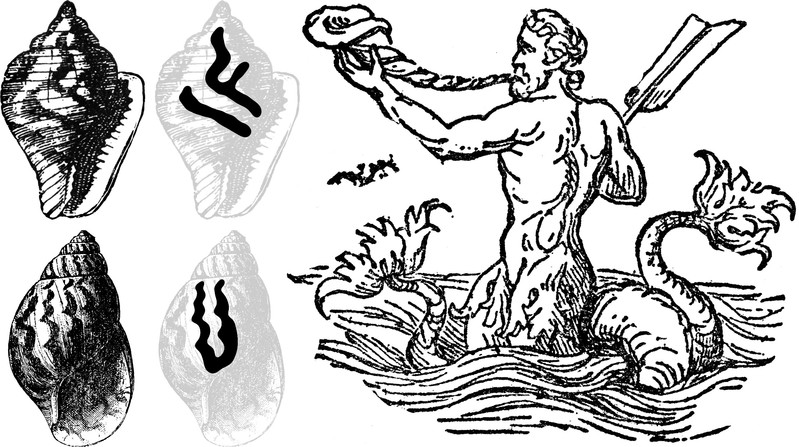
[This posting is in honor of Wilfried at Crystalpunk.) It is poetically said that when one raises a shell to the ear, one hears the ocean. Could it also be said that when one raises a shell to the eye, one reads poetry? In his masterpiece Doctor Faustus, Thomas Mann holds a magnifying glass to the "indecipherable hieroglyphics on the shells of certain mussels" and conchs, questioning whether Mother Nature expresses herself in an organized, written code, and whether ornament can ultimately be distinguished from meaning. Mann describes the calligraphy on a shell that practically begs to be understood: "The characters, as if drawn with a brush, blended into purely decorative lines toward the edge, but over large sections of the curved surface their meticulous complexity gave every appearance of intending to communicate something." The shell's calligraphy bears a strong resemblance to "early Oriental scripts, much like the stroke of Old Aramaic." But how is one to get to the bottom of such symbols? Mann admits that "They elude our understanding and, it pains me to say, probably always will." Yet this elusion need not be a source of discouragement. Mann explains that ornament and meaning are like conjoined twins: "When I say they 'elude' us, that is really only the opposite of 'reveal,' for the idea that nature has painted this code, for which we lack the key, purely for ornament's sake on the shell of one of her creatures--no one can convince me of that. Ornament and meaning have always run side by side, and the ancient scripts served simultaneously for decoration and communication. Let no one tell me nothing is being communicated here! For the message to be inaccessible, and for one to immerse oneself in that contradiction--that also has its pleasure." In other words, the shell calligraphy communicates a profound mystery, pregnant with meaning and delightful to behold. Mann admits that, "were this really a written code, nature would surely have to command her own self-generated, organized language," adding that nature's fundamental illiteracy is "precisely what makes her eerie." Mann's allusion to "early Oriental scripts" reminds us of the lost "shell" style of calligraphy discovered in Shang culture artifacts (14th - 11th centuries BCE). That ancient system of writing, more stylized than the early picture words, was brushed onto shells in vermilion ink. (For a full discussion of shell-style calligraphy, see Chinese Brushwork in Calligraphy and Painting by Kwo Da-Wei, 1990.) In our collage below, we imagine King Triton conjuring the Platonic ideals of shell calligraphy.
|
|
SONG: Super-Connected
ARTIST: Belly
ORIGINAL LYRIC:
Are there heart strings connected
To the wings you've got slapped on your back?
Better climb in the window cause I'm closing the door.
Now I'm spinning on a dime.
ADJUSTED FOR INFLATION:
Did Groucho inspire
Your distinctive moustache?
Climb up the barber pole, don't bat a lash.
Now I'm banking on the cash.
|
|
From A Surrealist Dictionary by J. Karl Bogartte: SWIMMING POOL: A kind of mist secreted by pyramids when fending off an attack of vicious glow-worms.
|
Page 2 of 4
> Older Entries...
Original Content Copyright © 2026 by Craig Conley. All rights reserved.
|







 by
by