CRAIG CONLEY (Prof. Oddfellow) is recognized by Encarta as “America’s most creative and diligent scholar of letters, words and punctuation.” He has been called a “language fanatic” by Page Six gossip columnist Cindy Adams, a “cult hero” by Publisher’s Weekly, a “monk for the modern age” by George Parker, and “a true Renaissance man of the modern era, diving headfirst into comprehensive, open-minded study of realms obscured or merely obscure” by Clint Marsh. An eccentric scholar, Conley’s ideas are often decades ahead of their time. He invented the concept of the “virtual pet” in 1980, fifteen years before the debut of the popular “Tamagotchi” in Japan. His virtual pet, actually a rare flower, still thrives and has reached an incomprehensible size. Conley’s website is OneLetterWords.com.
Portrait from Memoir of the Honorable Abbott Lawrence.
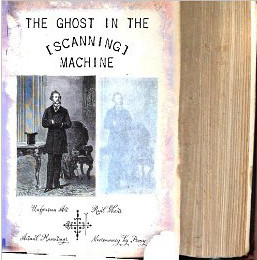
In this haunting, Laurence’s ghost appears four times, three of which resemble film negatives. Note also that the scanning machine has graced Laurence’s portrait with a striped aura.
"Every sentence includes an infinity of words; one perceives only a few of them, the others being in the infinite or being imaginary." —Raymond Queneau, qtd. in OULIPO: A Primer of Potential Literature
"It is not a good idea to combine symbols; the forces that stand behind them can easily start to mingle." —The Angel in the West Window, Gustav Meyrink's novel of the Elizabethan magus John Dee (our own 9th cousin)
I love the way Conley creates these series of what I want to call visual poems, only by default--only because there is no proper designation for a novel form. [In The Ghost in the [Scanning] Machine] we experience juxtaposed images of historical and not-so-historical personages cleanly engraved and then suddenly disappearing in a xeroxial fog of reproduction, a Banquo's feast of mirrors. These visual-textual series allow Conley to create the visual analogues of the serial poem, and into these delicious confections he works some of the best quotes in the English language (and many others, translated) to create an almost Midrashically complex, anachronistic interplay between image and text that often leads the mind to question the impossible interface that occurs daily--i.e., to ask how it is that words and objects could ever even come to a sort of harmony in the first place? It begins to seem beyond us. And beyond us is the metaphysical. So the circle runs, chasing its tail like the cat in that Siouxsie and the Banshees song. —W. B. Keckler, author of Sanskrit of the Body
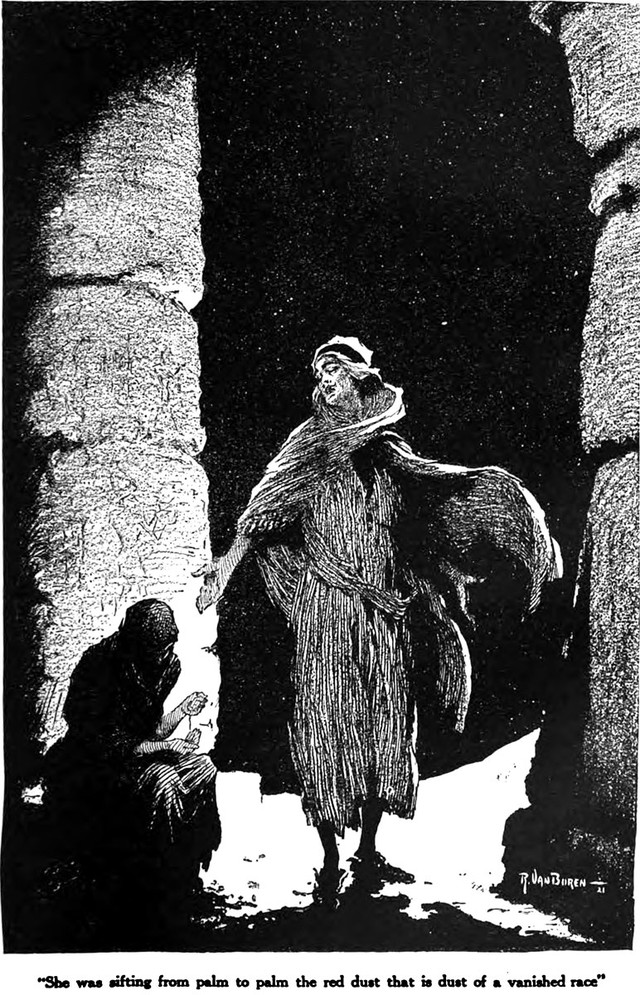
An illustration from a 1922 issue of Century Illustrated magazine. The caption reads: "She was sifting from palm to palm the red dust that is dust of a vanished race."
"A faint shadow stole over the room; while the countenance of the Medium had become so gloomy that the shadow seemed really only a reflection of it.” —Blackwood’s Magazine
"Begin by paying attention to your breath (and, yes, I know I'm repeating myself, but it bears repeating—we forget so fast and so often)." —James S. Gordon, Unstuck
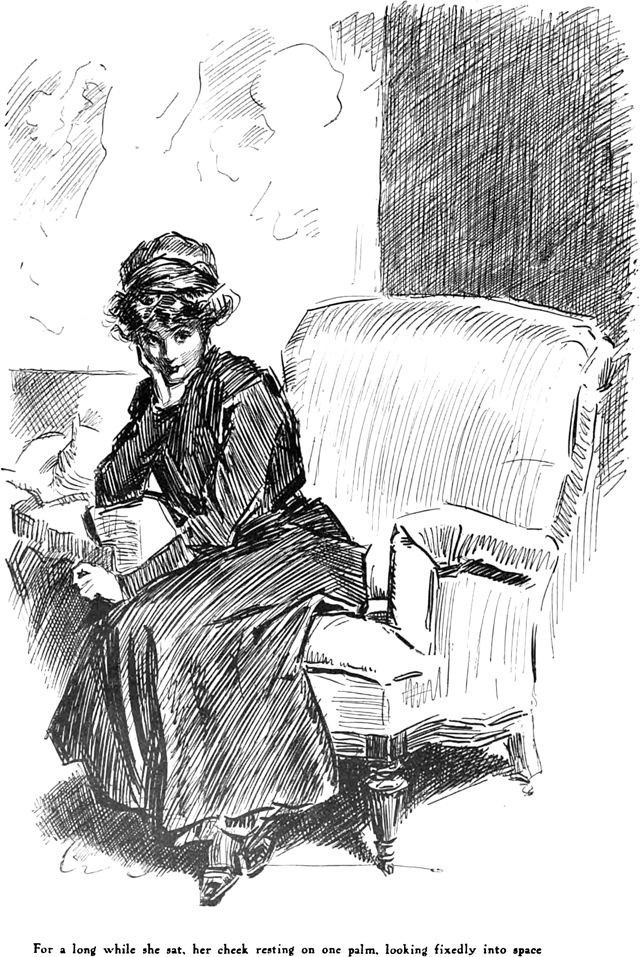
Staring into the depths: an illustration from a 1910 issue of Cosmopolitan magazine. The caption reads: "For a long while she sat, her cheek resting on one palm, looking fixedly into space."
"If I were a writer, how I would enjoy being told the novel is dead. How liberating to work in the margins, outside a central perception. You are the ghoul of literature. Lovely." —Don Delillo
"This may surprise you, but in order to escape yourself you must first stop trying to forget your worries, doubts, and fears." —Guy Finley, The Secret of Letting Go (2007)