|
|
 |
|
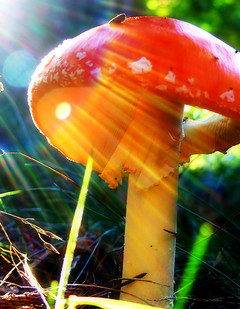
We found [mushrooms] in all shades of brown, yellow, and red, from velvet darks up to the most vivid orange scarlet. But most wonderful of all were the deep purple ones. Purple has always been to me the mystery color, the magician's color. All the mushrooms looked very wise and as if they could weave spells and incantations, but the purple ones were the Merlins of the wood.
—Una Hunt, Una Mary: The Inner Life of a Child, 1914.
|
|
|
|
|
|
| I Found a Penny Today, So Here's a Thought |
(permalink) |
|
|
|
  by TzatzikiTeardrops as PrismsIntense moments in life can bring tears of both joy and pain. There can also be tears of something that transcends bodily feelings and emotions. These are tears of realization, when a union of some sort transforms into communion, or a passion transforms into compassion. "Bliss" might be the best word for this tearful state of being, though words are too limited. One way to inspire such tears is to look deeply into someone's eyes and to hold the gaze. A friend once shared the insight that teardrops are prisms, reflecting and refracting angles and colors of life that can't be seen with dry eyes. Mozambique author Mia Couto suggests that tearful eyes are liquid conduits to the world of the unconscious, and that through the prism of a teardrop you can see visions of things not as you wish they were but as they really are. It's as if teardrops dissolve away one's defensive walls to reveal the archetypes dwelling in the background, the mythology taking place beneath the surface of the workaday world. Throughout the ages, the joys, pains, and revelations of life have invited artists to gaze through teardrop prisms and to share their visions. [Read the entire article in my guest blog at ColourLovers.com.]
|
|
Big gray [moths] with reddish markings, pale blue- green, yellow with lavender, and red and yellow."
"What do you mean by 'red and yellow?'" asked the Bird Woman so quickly that the girl almost jumped.
"Not exactly red," explained Elnora, with tremulous voice. "A reddish, yellowish brown, with canary- coloured spots and gray lines on their wings."
—Gene Stratton-Porter, A Girl of the Limberlost, 1909.
|
|
|
|
|
|
| I Found a Penny Today, So Here's a Thought |
(permalink) |
|
|
|
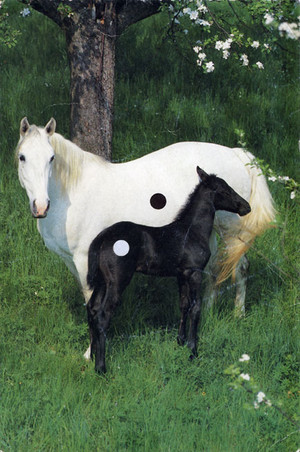
"Horses are, in fact, natural Taoists. ... Taoism is best known in popular culture for the 'yin-yang' circle, its two interlocking tadpole-like symbols representing the balance of opposites in the universe and in the human psyche: white and black, light and dark, sound and silence, doing something and doing nothing. To the relentlessly assertive, patriarchal Western mind, the Taoist picture of reality at first appears contrary to everything we believe because it asks us to consider the opposite of our normal inclinations. One of the most famous quotes from the Tao Te Ching advises us to 'know the yang, but keep to the yin,' which often appears in translation as 'know the masculine but keep to the feminine.' When I was with horses, I began to live this philosophy." — Linda Kohanov, The Tao of Equus |
|
Piecing together the secret of the ruined castle . . . |
|
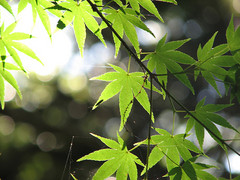
The sun came down through miles of leaves and got broken up like a pointillist painting, deep green and dapple shadows but brilliant light in a soaring deep green super- bower, a perpetual lime- green light, green- and- gold afternoon, stillness, perpendicular peace, wood- scented, with the cars going by on Route 84 just adding pneumatic sound effects, sheee- ooooooooo, like a gentle wind.
—Tom Wolfe, The Electric Kool-Aid Acid Test, 1968
|
|
|
|
|
|
Piecing together the secret of the rose . . .
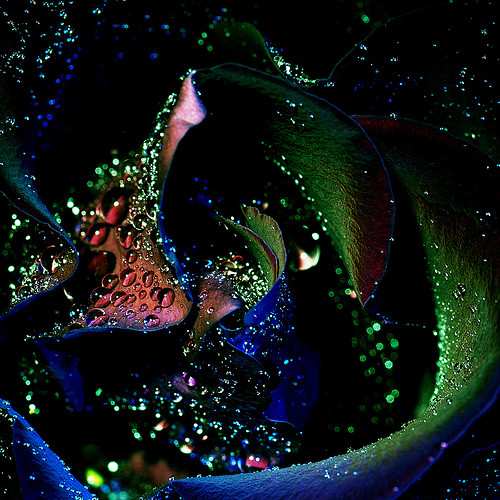
A red rose misted with water and illuminated by multicolored LED flashlights. Photo by Tio.
|
|
|
|
|
|
| I Found a Penny Today, So Here's a Thought |
(permalink) |
|
|
|
 by Claire L. EvansUnusual Color WheelsThe first color wheel (a.k.a. color circle) has been traced back to Sir Isaac Newton, who in 1706 arranged red, orange, yellow, green, blue, indigo, and violet into a natural progression on a rotating disk. As the disk spins, the colors blur together so rapidly that the human eye sees white. Artists have been experimenting with color wheels ever since, finding inspiration in everything from cocktail umbrellas, river rocks, autumn leaves, pencil shavings, to juggling. The Happy Hour color wheel consists of exotic cocktail umbrellas. It was created by Bright Lights Little City: 
The Rocks color wheel is a collection of stones from Salmon River, Idaho. It was assembled by Purl Bee: 
This Yarn Skeinlet color wheel features dyes made of cochineal (ground up cactus-eating scale insects), osage orange, chamomile, indigo and logwood. It was created by Sarah of the Blue Garter blog: 
The Circle of Life color wheel was created by Thalandor as a tribute to the artist Mother Nature: 
This Kusudama (Medicine Ball) color wheel was created by Origami artist Vanessa Gould: 
The Pencil Shavings color wheel was photographed by Myruby: 
This Garden Blossom color wheel is the work of Tiny Haus: 
The Juggler color wheel was painted by Kenneth Callicutt: 
The Chalk color wheel was photographed near Parc De La Villette, Paris, by Jacobz: 
[Read the entire article in my guest blog at ColourLovers.com.]
|
|
|
|
|
|
| I Found a Penny Today, So Here's a Thought |
(permalink) |
|
|
|
Migraines That Erase Color
Chronic pain has its own devastating side effects, even in the absence of medication. Sufferers of migraine headaches sometimes report a phenomenon that amounts to color-blindness. Jeff of the Omegaword blog explains that chronic pain has a peculiar way of removing color from the world. He poetically describes his experience of a reality in which all color has been erased by bursts of red:
"Red has never been my favorite color. Bolts of hot pain sear the world, leaving me colorblind but for the shards that stay behind — jagged red reminders of pain past, and pain yet to come. Through the window, beyond the mute interplay of light and shadow on a white kitchen wall, bare branches against a pale sky remind me that it's all in my head. What color are light waves, anyway?"
A new study of synesthesia confirms Jeff's observation that the color of the world is all in one's head. Cretian van Campen, author of The Hidden Sense: Synesthesia in Art and Science (2007), explains: "A mysterious aspect of color is that it is created in the brain and seen to exist in the physical environment. But the physical environment contains only light waves and is in fact colorless. The colors are inside our brains, not outside."
Color palettes sometimes testify to hues that have been displaced or erased by profound circumstances. For example, COLOURlover Codename Gimmick envisions the frosty onset of winter as a time when "frequencies from red to yellow have been silenced." His "Frost-Over" palette celebrates red and yellow through their striking absence.

With the palette "Another Migraine?" COLOURlover Stefan depicts a reality reduced to lavender, punctuated by an occasional throb of neon yellow.

COLOURlover Manekineko envisions a world so desaturated that only dull grays remain.

Migraine-inspired palettes from the COLOURlovers library testify to the phenomenon that chronic pain can distort or dampen one's experience of color. Luckily, some artists seem able to retain a keen color sensibility even within the confines of a migraine headache.
[Read the entire article in my guest blog at ColourLovers.com.]
---
Gia writes:
Interesting. Migraines are just the opposite to me. Imagine the brightest yellow, neon +++++, electrified, magnified, and shot directly to your brain. Behind the eyes, a violent pink, raw, bleeding and sore. Add some touches of green—outer space green. Glowing and undulating, slowly creeping over the entire length of your body, quieting your every cell.
Yeah.
That's close.
|
|
|
|
|
|
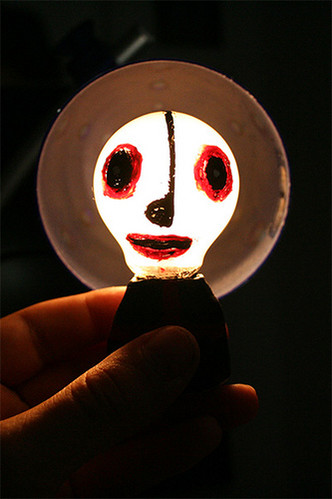
A saint made of plasticine and a light bulb, by Ukrainian artist Eugene Rudyy. |
|
Without the actual use of color or light, the English composer Arthur Bliss wrote ‘A Colour Symphony’ having four movements. Here Bliss sought to convey the musical and emotional impression of four colors.
‘I. Purple: The Colour of Amethysts, Pageantry, Royalty and Death.
II. Red: The Colour of Rubies, Wine, Revelry, Furnaces, Courage and Magic.
III. Blue: The Colour of Sapphires, Deep Water, Skies, Loyalty, and Melancholy.
IV. Green: The Colour of Emeralds, Hope, Youth, Joy, Spring and Victory.’
The symphony was written in 1922, first presented in Gloucester Cathedral, and revised by the composer in 1932.
—Tom Douglas Jones, The Art of Light and Color, 1972.
|
Page 4279 of 4337
Original Content Copyright © 2026 by Craig Conley. All rights reserved.
|





 by