|
|
 |
|
| I Found a Penny Today, So Here's a Thought |
(permalink) |
|
|
|
Husbands and Knives:
Twenty Shocking Parallels in the Lives of
Yukio Mishima and Woody Allen
1. Residents of Westernized islands. 2. Short male persons. 3. Directors shunned by Hollywood. 4. Existentialists. 5. Commited public "suicide." 6. Expressed nostalgic yearning. 7. Avidly absorbed the culture of the East (or the Upper East Side). 8. Withstood vulgar curiosity about biographical anecdotes. 9. Obsessed with social disgrace.
10. Strong feelings about raw fish.
11. Involved with Asian women.
12. Interested in masks and disguises to express facets of their personality.
13. Fascinated by their own celebrity.
14. Recounted traumatic episodes from youth.
15. Attended tea ceremonies (or at least the Russian Tea Room).
16. Brandished phallic symbol representative of their art (sword/clarinet).
17. Forged in the smithy of their souls the uncreated conscience of their race.
18. Resisted fulfilling the role of son, husband, and father, yet desired to preserve ancestral tradition.
19. Wore costumes of period which they believed themselves to personify (Samurai robe/trenchcoat).
20. Died in their thoughts every morning.
|
|
|
|
|
|

The strange language spoken by circus owner Papa Lazarou, from the British dark comedy series The League of Gentlemen, may technically be gibberish ("Autom, sprow. Cana, tik bana! Sandwol, but no sera smee?") But it was inspired by Parlari, the private language of traveling British circus folk.
Pioneering West African composer Julien Jacob sings in his own mysterious, imaginary language, allowing his listeners to interpret his songs in their own way.
More from AskMefi: I'm 6'8". People are always asking me how tall I am. Instead of telling the truth, what are some witty, non-confrontational responses I might use? "Depends on where you start measuring." Vesona
is a universal language proposed by Dr. Alesha Sivartha, in which the
first two or three letters of any word give the general meaning and the
added letters specialize these meanings. An elaborate circular diagram (copy and paste link in new window) shows how Vesona encapsulates all of human knowledge. Verdurian
is a language spoken by 55 million imaginary people. The fruitful
creativity of Mark Rosenfelder offers background on the history,
grammar, and literature of Verdurian, as well as a Language Kit for constructing your own artificial languages. How to say How many flowers are in Pia Zadora's vase? in Esperanto? From Prolific Lo-Fi recording artist Ken Clinger,
who records songs in both English & Esperanto. He juxtaposes
awkward practice sentences from foreign language tutorials, creating
absurd, surreal alternate realities.
Why English is a Silly Language.
"It's really a wonder that any one manages to successfully speak
English at all. That people learn it all over the world is just
incredible... I mean amazing."
Tlön, Uqbar, Orbis Tertius. Jorge Luis Borges dreamed of a language called Ursprache
with absolutely no nouns. For example, there's no word for "moon," but
there's a verb meaning "to moon" or "to moonate." The sentence "The
moon rose above the water" in Ursprache would translate as "Upward
behind the onstreaming it mooned." The hypothetical lost continent of Mu (also known as Lemuria)
is said to have been destroyed in a global upheaval tens of thousands
of years ago. Unorthodox researcher Col. James Churchward believed he
rediscovered Mu's alphabet, comprised of beautiful and intricate glyphs. This is a post that I am “co-blogging” with Hanan Levin of Grow-a-Brain. Thank you, Hanan, for the links you suggested!
|
|
"Is that a fact?" That is not a fact, but is either a pronoun or an adjective.
|
|
Beautiful Woman“I was thinking that a beautiful woman could provide a, uh, diversion.”
“Here we go again. Cherchez la femme. The oldest trick in the book.”
—Clive Cussler, Polar Shift (2005)
Baited by a broad—the oldest trick in the book.
—F. Paul Wilson, “The Lord’s Work,” The Mammoth Book of Dracula (1997)
|
|
|
|
|
|
Ben Macintyre of The Times
is against the bid to flush semicolons out of our prose — what he calls
"semi-colonic irrigation." He makes the following lovely point:
The beauty of the semi-colon lies in
its very vagueness. It indicates both connection and division. It is a
gentle way of connecting thoughts, without applying the abrupt brake of
a full stop or the breathiness of a comma. It implies a qualification
or refinement of the idea stated in the first part of the sentence.
Sometimes a string of semi-colons shows an evolving idea or
description, a string of interconnected ideas.
Virginia Woolf opens Mrs Dalloway with a lovely spray of semi-colons:
“How fresh, how calm, stiller than this of course, the air was in the
early morning; like the flap of a wave; the kiss of a wave; chill and
sharp and yet (for a girl of 18 as she was then) solemn, feeling as she
did, standing there at the open window, that something awful was about
to happen; looking at the tress with smoke winding off them and the
rooks rising, falling; standing and looking . . . ” |
|
|
|
|
|
Staring At the Sun
I shake
And stare the sun
Till my eyes burn
— David Bowie, "The Voyeur of Utter Destruction"
Light is sweet, and it is pleasant for the eyes to behold the sun. — Ecclesiastes
The dawn ventures to confont the sky decorated with multiple colors ...
My eyes have an entirely different brilliance. I am afraid they
will make holes in the sky. —Nietzsche
The biggest drawback to mirrorshades is that they simulate a state of
permanent solar eclipse, a twilight world in which colors are distorted
and shadows are deeper. The sun has been both feared and revered
throughout human history, but only a handful of people have actually
had the courage to look it in the face. Granted, the naked eye
will sustain impairment if exposed to direct sunlight for too
long. Therefore, cyberpunk author Paul Di Filippo recommends
optical implants as a solution. “By stepping down the ratio of
photons to electrons,” he suggests, “you can do such things as stare
directly at the sun or at a welder’s flame without damage.”
But why stare into the sun in the first place? Because it's
dangerous. Because it's deviant. Because so few are man
enough to try it. Because radiation is natural. Because it
looked at you first. Perhaps the best reason of all is that the
sun frees us from the simplistic dogma of dualism. Photons of
light have no antiparticle. That means that in the world of light
there is no division between body and soul, good and evil, seer and
scenery, past and future, man and fellow man. In the world of
light, 1 + 1 = 1.
Photographs of the sun are typically taken through telescopes.
Such photographs are pale substitutes for actually looking at the
sun. As naturalist Annie Dillard notes in an essay about
witnessing a total eclipse, "The lenses of telescopes and cameras can
no more cover the breadth and scale of the visual array than language
can cover the breadth and simultaneity of internal experience.
Lenses enlarge the sight, omit its context, and make of it a pretty and
sensible picture, like something on a Christmas card." Scientific
instruments, then, limit our perception even as they extend the range
of our vision. No matter what apparatus we use to view the sun,
at some point we will encounter a "blind spot." Clearly, the
naked eye (capable of detecting a single photon of light) or naked
implant is the only way to go.
There are two steps to proper sun-staring. First, stare at the
sun with the eyes open. This is not an easy thing to do.
Rochefoucauld, the Benjamin Franklin of France, once said that "Neither
the sun nor death can be looked at with a steady eye." He was
correct. In his novel Staring at the Sun, Julian Barnes warns
that "You can't stare at the sun for too long--not even the setting,
quiet sun. You would have to put your fingers in front of your
face to do that." So don't have any preconceptions that it's
going to be simple or pleasant. Try not to blink. Try not
to look away. Shield your eyes with your fingers at first if you
must, but then slowly spread your fingers to reveal the awesome light
of the sun. If you must look away then do so, but slowly bring
your eyes back to the sun. If you find yourself involuntarily
blinking rapidly, hold your eyelids open with your fingers.
Second, stare at the sun with the eyes closed. The sun's
afterimage will remain under your eyelids, indelibly etched into your
cornea. James Patrick Kelley describes this phenomenon in his
cyberpunk story "Solstice": "Cage shut his eyes and still he
could see it: blood red, flashing blue, veins pulsing across its
surface."
What is the significance of this afterimage? No doubt each person
must find his omn answer to this question. In her novel Century 21,
Ewa Kuryluk attempts a philosophical answer. She says that "We
must preserve the sun's afterimage under our lids" because it forces us
to confront "ideals, abstract beings which are neither bodies nor
forces dwelling in bodies." Perhaps she means that we can harness
the sun's forces, snatch them from the physical body of the star, and
carry them with us--literally within our eyelids. In any case,
Kuryluk seems to be touching upon a deeper truth about the perception
of reality.
The French poet Paul Claudel agrees with Kuryluk that we can carry the
body of a star within our eyelids, making us the center of our own
private solar system. "We can see in the eye a sort of scaled
down, portable sun," he says, "and therefore, a prototype of the
ability to establish a radius from it to any point on the
circumference." The German poet Yvan Goll describes such a
private solar system:
The universe revolves around you
Eye with
facets which chase away the eyes of the stars
And implies them in
your gyratory system
Carrying away nebulas of eyes in your madness.
The Maja-Ratri, a Sanskrit
text, says that light is the source of all thought, since light is a
combustion of star evolution. That star evolution exists in the
inner dimensions of your mind as a phosphene explosion.
Psychologist Carl Jung once wrote that "when our senses react to real
phenomena, sights, and sounds, they are somehow translated from the
realm of reality into that of the mind. Within the mind they
become psychic events, whose ultimate nature is unknowable."
If you're eventually going to have your eyes replaced anyway, why not
burn them out in a single blaze of glory? Besides, the
combination of sunglasses and a walking stick is a timeless fashion
statement.
|
|
|
|
|
|
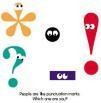
From The Which Punctuation Mark Are You Test:
"Congratulations! You are the semicolon! You are the highest expression
of punctuation; no one has more of a right to be proud. In the hands of
a master, you will purr, sneering at commas, dismissing periods as
beneath your contempt. You separate and connect at the same time, and
no one does it better. The novice will find you difficult to come to
terms with, but you need no one. You are secure in your elegance,
knowing that you, and only you, have the power to mark the skill or
incompetence of the craftsman. You have no natural enemies; all fear
you. And never, NEVER let anyone tell you that you cannot appear in
dialogue!" |
|
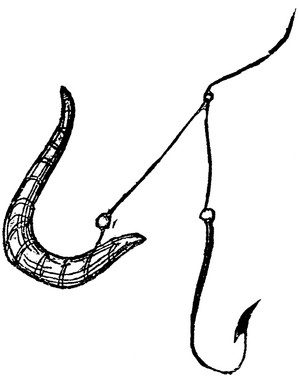
Baiting a Hook“Trick” is dlllos in Homeric Greek, and the oldest known use of the term refers to a quite specific trick: baiting a good to catch a fish. East and west, north and south, this is the oldest trick in the book. No trickster has ever been credited with inventing a potato peeler, a gas meter, a catechism, or a tuning fork, but trickster invents the fish trap.
—Lewis Hyde, Trickster Makes This World (1998)
|
|
|
|
|
|
Speaking of semicolons, I stumbled upon the most marvelous poem by Matt
"World's Best Writer Ever" Getty, entitled "Inside the Semicolon
(Draft)." Here's the first stanza:
The sinister semicolon lurks
on the inside. Always inviting,
he calls you to follow as he opens
doors that look like walls.
To read more (you'll be glad you did), see the poetry section of Matt's website. |
|
|
|
|
|
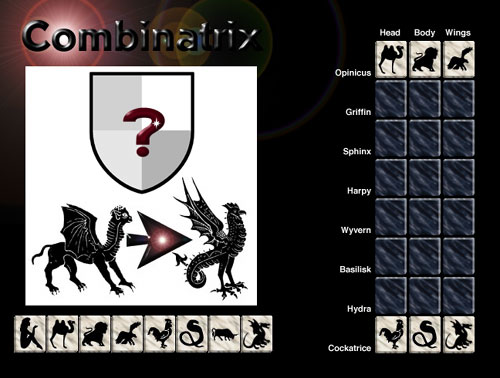
This is a puzzle in which you try to
transform one mythological creature into another. Drag tiles from
the bottom left into the grid on the right, forming the proper head,
body, and wings of each creature listed. Each line of the grid
will feature only one change from the row immediately above. When
the grid is complete, click the large arrow to test your matrix.
The first person to send a screen shot of the winning matrix will receive a free set of One-Letter Words Knowledge Cards! Send it to solution @ pobox.com.
Click the image below to launch the game ( Shockwave plug-in required). The file size is 1.2 MB.
|
|
|
|
|
|
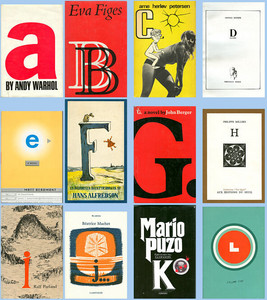
After six years of determined searching, Lars Rasmussen, a purveyor of fine used books, collected a complete alphabet of books with one letter for titles (including Scandinavian letters). He was inspired by this quotation from James Joyce's Ulysses:
Have you read his F?
O yes, but I prefer Q.
Yes, but W is wonderful.
O yes, W. |
|
| I Found a Penny Today, So Here's a Thought |
(permalink) |
|
|
|
|
|
|
|
|
|
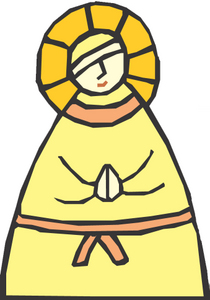
Here's a strange dream:
I dreamed I was among a group of people being tortured very
viciously. Our assailants were cutting off hands and feet, using
sharp metal rods for impaling, and so on. I noticed that one of
my fellow victims, a woman, had a tiny round bandage on her
forehead. I recognized this as evidence that she had been impaled
through the head, and I deeply dreaded such a fate for myself.
(In retrospect, I associate this small circle with the Hindu "bindi"
representing the Third Eye, but in the dream this didn't occur to
me.) At some point during my torture, I gained
enlightenment. I felt the music of the universe enter my body
through my root chakra, and I felt myself "puffing up" like a balloon
being filled, especially in my belly. I floated in bliss for a
while. When my awareness focused back on the physical plane, I
saw two Hindus holding up their hands in prayer and bowing to me
reverently, acknowledging my holiness. I returned the
honor. One of them opened a book to show me which deity was my
overseer or lord in the greater hierarchy of things. I don't
remember the god's name, but I remember reading these words: "This god
is associated with endings and beginnings." I scoffed slightly,
thinking that the description was too generic. "That's what
they're ALL associated with," I thought to myself. (In
retrospect, I realize that my overseer is Agni, the Hindu two-headed
god of fire who rules over the digestive fires in the belly.) I
only vaguely recall subsequent scenes of my dream in which I was
operating as an enlightened being and interacting with my
followers. I certainly felt happy bestowing benevolence.
|
Page 2 of 3
> Older Entries...
Original Content Copyright © 2026 by Craig Conley. All rights reserved.
|








 = Tiger Woods is awesome, and other helpful phrases from the