|
|
|
|
|
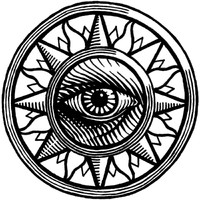
Staring At the Sun
I shake
And stare the sun
Till my eyes burn
— David Bowie, "The Voyeur of Utter Destruction"
Light is sweet, and it is pleasant for the eyes to behold the sun. — Ecclesiastes
The dawn ventures to confont the sky decorated with multiple colors ...
My eyes have an entirely different brilliance. I am afraid they
will make holes in the sky. —Nietzsche
The biggest drawback to mirrorshades is that they simulate a state of
permanent solar eclipse, a twilight world in which colors are distorted
and shadows are deeper. The sun has been both feared and revered
throughout human history, but only a handful of people have actually
had the courage to look it in the face. Granted, the naked eye
will sustain impairment if exposed to direct sunlight for too
long. Therefore, cyberpunk author Paul Di Filippo recommends
optical implants as a solution. “By stepping down the ratio of
photons to electrons,” he suggests, “you can do such things as stare
directly at the sun or at a welder’s flame without damage.”
But why stare into the sun in the first place? Because it's
dangerous. Because it's deviant. Because so few are man
enough to try it. Because radiation is natural. Because it
looked at you first. Perhaps the best reason of all is that the
sun frees us from the simplistic dogma of dualism. Photons of
light have no antiparticle. That means that in the world of light
there is no division between body and soul, good and evil, seer and
scenery, past and future, man and fellow man. In the world of
light, 1 + 1 = 1.
Photographs of the sun are typically taken through telescopes.
Such photographs are pale substitutes for actually looking at the
sun. As naturalist Annie Dillard notes in an essay about
witnessing a total eclipse, "The lenses of telescopes and cameras can
no more cover the breadth and scale of the visual array than language
can cover the breadth and simultaneity of internal experience.
Lenses enlarge the sight, omit its context, and make of it a pretty and
sensible picture, like something on a Christmas card." Scientific
instruments, then, limit our perception even as they extend the range
of our vision. No matter what apparatus we use to view the sun,
at some point we will encounter a "blind spot." Clearly, the
naked eye (capable of detecting a single photon of light) or naked
implant is the only way to go.
There are two steps to proper sun-staring. First, stare at the
sun with the eyes open. This is not an easy thing to do.
Rochefoucauld, the Benjamin Franklin of France, once said that "Neither
the sun nor death can be looked at with a steady eye." He was
correct. In his novel Staring at the Sun, Julian Barnes warns
that "You can't stare at the sun for too long--not even the setting,
quiet sun. You would have to put your fingers in front of your
face to do that." So don't have any preconceptions that it's
going to be simple or pleasant. Try not to blink. Try not
to look away. Shield your eyes with your fingers at first if you
must, but then slowly spread your fingers to reveal the awesome light
of the sun. If you must look away then do so, but slowly bring
your eyes back to the sun. If you find yourself involuntarily
blinking rapidly, hold your eyelids open with your fingers.
Second, stare at the sun with the eyes closed. The sun's
afterimage will remain under your eyelids, indelibly etched into your
cornea. James Patrick Kelley describes this phenomenon in his
cyberpunk story "Solstice": "Cage shut his eyes and still he
could see it: blood red, flashing blue, veins pulsing across its
surface."
What is the significance of this afterimage? No doubt each person
must find his omn answer to this question. In her novel Century 21,
Ewa Kuryluk attempts a philosophical answer. She says that "We
must preserve the sun's afterimage under our lids" because it forces us
to confront "ideals, abstract beings which are neither bodies nor
forces dwelling in bodies." Perhaps she means that we can harness
the sun's forces, snatch them from the physical body of the star, and
carry them with us--literally within our eyelids. In any case,
Kuryluk seems to be touching upon a deeper truth about the perception
of reality.
The French poet Paul Claudel agrees with Kuryluk that we can carry the
body of a star within our eyelids, making us the center of our own
private solar system. "We can see in the eye a sort of scaled
down, portable sun," he says, "and therefore, a prototype of the
ability to establish a radius from it to any point on the
circumference." The German poet Yvan Goll describes such a
private solar system:
The universe revolves around you
Eye with
facets which chase away the eyes of the stars
And implies them in
your gyratory system
Carrying away nebulas of eyes in your madness.
The Maja-Ratri, a Sanskrit
text, says that light is the source of all thought, since light is a
combustion of star evolution. That star evolution exists in the
inner dimensions of your mind as a phosphene explosion.
Psychologist Carl Jung once wrote that "when our senses react to real
phenomena, sights, and sounds, they are somehow translated from the
realm of reality into that of the mind. Within the mind they
become psychic events, whose ultimate nature is unknowable."
If you're eventually going to have your eyes replaced anyway, why not
burn them out in a single blaze of glory? Besides, the
combination of sunglasses and a walking stick is a timeless fashion
statement.
|
|
|
|
|
|
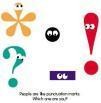
From The Which Punctuation Mark Are You Test:
"Congratulations! You are the semicolon! You are the highest expression
of punctuation; no one has more of a right to be proud. In the hands of
a master, you will purr, sneering at commas, dismissing periods as
beneath your contempt. You separate and connect at the same time, and
no one does it better. The novice will find you difficult to come to
terms with, but you need no one. You are secure in your elegance,
knowing that you, and only you, have the power to mark the skill or
incompetence of the craftsman. You have no natural enemies; all fear
you. And never, NEVER let anyone tell you that you cannot appear in
dialogue!" |
|
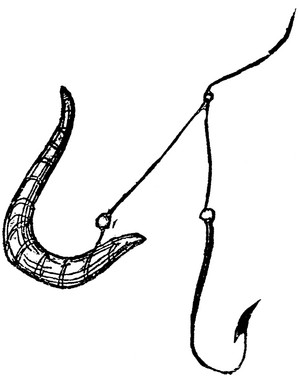
Baiting a Hook“Trick” is dlllos in Homeric Greek, and the oldest known use of the term refers to a quite specific trick: baiting a good to catch a fish. East and west, north and south, this is the oldest trick in the book. No trickster has ever been credited with inventing a potato peeler, a gas meter, a catechism, or a tuning fork, but trickster invents the fish trap.
—Lewis Hyde, Trickster Makes This World (1998)
|
|
|
|
|
|
Speaking of semicolons, I stumbled upon the most marvelous poem by Matt
"World's Best Writer Ever" Getty, entitled "Inside the Semicolon
(Draft)." Here's the first stanza:
The sinister semicolon lurks
on the inside. Always inviting,
he calls you to follow as he opens
doors that look like walls.
To read more (you'll be glad you did), see the poetry section of Matt's website. |
|
|
|
|
|
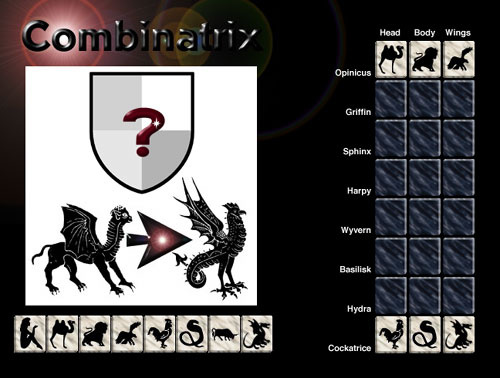
This is a puzzle in which you try to
transform one mythological creature into another. Drag tiles from
the bottom left into the grid on the right, forming the proper head,
body, and wings of each creature listed. Each line of the grid
will feature only one change from the row immediately above. When
the grid is complete, click the large arrow to test your matrix.
The first person to send a screen shot of the winning matrix will receive a free set of One-Letter Words Knowledge Cards! Send it to solution @ pobox.com.
Click the image below to launch the game ( Shockwave plug-in required). The file size is 1.2 MB.
|
|
|
|
|
|
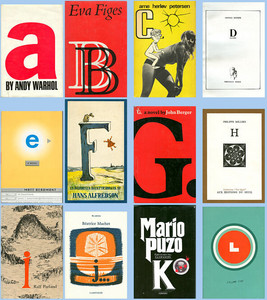
After six years of determined searching, Lars Rasmussen, a purveyor of fine used books, collected a complete alphabet of books with one letter for titles (including Scandinavian letters). He was inspired by this quotation from James Joyce's Ulysses:
Have you read his F?
O yes, but I prefer Q.
Yes, but W is wonderful.
O yes, W. |
|
| I Found a Penny Today, So Here's a Thought |
(permalink) |
|
|
|
|
|
|
|
|
|
Here's a strange dream:
I dreamed I was among a group of people being tortured very
viciously. Our assailants were cutting off hands and feet, using
sharp metal rods for impaling, and so on. I noticed that one of
my fellow victims, a woman, had a tiny round bandage on her
forehead. I recognized this as evidence that she had been impaled
through the head, and I deeply dreaded such a fate for myself.
(In retrospect, I associate this small circle with the Hindu "bindi"
representing the Third Eye, but in the dream this didn't occur to
me.) At some point during my torture, I gained
enlightenment. I felt the music of the universe enter my body
through my root chakra, and I felt myself "puffing up" like a balloon
being filled, especially in my belly. I floated in bliss for a
while. When my awareness focused back on the physical plane, I
saw two Hindus holding up their hands in prayer and bowing to me
reverently, acknowledging my holiness. I returned the
honor. One of them opened a book to show me which deity was my
overseer or lord in the greater hierarchy of things. I don't
remember the god's name, but I remember reading these words: "This god
is associated with endings and beginnings." I scoffed slightly,
thinking that the description was too generic. "That's what
they're ALL associated with," I thought to myself. (In
retrospect, I realize that my overseer is Agni, the Hindu two-headed
god of fire who rules over the digestive fires in the belly.) I
only vaguely recall subsequent scenes of my dream in which I was
operating as an enlightened being and interacting with my
followers. I certainly felt happy bestowing benevolence.
|
|
Bait and SwitchHe had fallen for the oldest trick in the book, the one con-men called bait-and-switch: if you tell a lie and get caught, back up and tell half the truth.
—Stephen King, Needful Things (1991)
|
|
SONG: Operator (That's Not the Way It Feels)
ARTIST: Jim Croce
ORIGINAL LYRIC:
Thank you for your time
Oh, you've been so much more than kind
And you can keep the dime
ADJUSTED FOR INFLATION AND CULTURAL TRENDS by Jonathan Caws-Elwitt:
Thanks for listening hard
On a cell phone in your yard
There goes my calling card
|
|
|
|
|
|
What makes a great story? Marketing expert Seth Godin
suggests that "The best stories don't teach people anything new.
Instead, the best stories agree with what the audience already believes
and makes the members of the audience feel smart and secure when
reminded how right they were in the first place." (Thanks, Gordon!) |
|
|
|
|
|
In English:
Two people were sitting by a fence. The first says:
"Tell me, if I'm looking at you, and thinking of something, and you
know that I'm thinking of that thing, and you're thinking of the same
thing, isn't it just as if we had said it?"
"Well, yes..."
"Then, which of us is it like he had said it?"
Translated into Zoinx:
ona be brazer ves unta`i, dalto`i. sila ro'st i tan:
= silali ga fen go, en nebasi go he`i ga, san fermisi go man xiruli,
san esasi ga mse`i fermisi go man set, san fermisi ga man tira, i`aneka
set vor mse`i silata gi`o'st? =
= sen dot... =
= san, eni`oka set ane`i fen gi`o, mse`i i`a'st vor mse`i silata ge`i set? =
The Zoinx
language (invented in 1993), does not have a fictional population of
speakers or a corresponding history, yet "quite a bit of cultural
information can be gathered from the language itself."
|
|
|
|
|
|
I was in the most dangerous part of town you could imagine. It reminded me of the most hellish neighborhood in the Australian Outback. A large woman with a dark complexion came out of a building (which I associated with a prison) and asked me to do her a favor. She said she needed help pushing a tissue through a slot across the street. The tissue was draped over the end of a tool, presumably a screwdriver. The task sounded simple enough, and she was pushy enough that I obliged. She walked behind me, thrusting me forward rather gruffly, and I told myself not to take her behavior the wrong way. I imagined that she had many children and was experienced in having to shove them around to keep them in line. Up ahead I saw our destination, and it filled me with fear. It was like a solitary phone booth, but it was a cage with prison bars, and it was virtually bursting with menace. I suspected that someone criminally insane was inside that cell. "What's going to happen?" I asked my companion. "I don't know" was all she said, though we were both thinking that those bars could give way any moment. When we got up to the cage, I saw that it was swarming with many people inside, all either criminally insane or hopelessly deformed monstrosities. I couldn't help but wonder whether or not there were better ways to deal with these people than this outdoor cage -- weren't there advances in plastic surgery that could help? Or were their grotesque deformities evidence of a twisted energy present at the time of reincarnation? And should we be suspicious of dwarves? The woman ushered me toward the bars, and I cautiously inched the screwdriver toward the bars until the tissue fell off and was grabbed by one of the crouching inmates. Then the woman and I fled as fast as we could, lest the little prison cell break loose like a Pandora's Box and subject us to the fallout. Later in the dream, I was telling this experience to my mother, and I recalled more details. I remembered feeling that something had to be resolved regarding this prison. I went back to it, and this time the inmates were quiet, calmly studying me. I looked at my hand, then realized what to do. The cage now inexplicably half full of water, I dipped the screwdriver into the water so as to drip some of the water onto my palm. The water was thick and opaque and looked like semen. I knew that I had to cut myself and allow the water to mix with my blood. I knew that this water was from the River Styx, and that instead of poisoning me it would give me immortality. I pushed the screwdriver (which I now noticed to be barbed) all the way through my palm without pain.
|
|
SONG: I Wanna Be A Dancin' Man
ALBUM: The Belle of New York Soundtrack
ORIGINAL LYRIC:
Gonna leave my footsteps on the sands of time,
If I never leave a dime.
ADJUSTED FOR INFLATION:
Gonna leave my footsteps in bricks and mortar,
If I never leave a quarter.
|
|
I dreamed I couldn't be sure the independent clauses were not joined by a connective.
Later that night, I dreamed I visited Arabia, where my people walk upside down.
Then I dreamed that I was a Greek question mark, though of course I looked the same as I always do.
That was followed by a nightmare about a young bully named Nicholas
Semicolon, strikingly similar to the shameful character with the same
name in HELLO, MRS. PIGGLE-WIGGLE by Betty MacDonald. |
|
BacktrackingThis is the oldest trick in the book. These are the same people who attacked us earlier. This is just round two.
—Diane Carey, Challenger (2000)
|
Page 4336 of 4338
Original Content Copyright © 2026 by Craig Conley. All rights reserved.
|